Unified Automated Threat Models Are Here

Date
Authors
Tony UV
Follow Us


Automated threat modeling platforms increasingly promise to unify technical findings with business context and automate the workflow between identifying a risk and resolving it. This paper examines the specific, externally documented problems that this kind of platform is built to address: ownership ambiguity in vulnerability remediation, a wide and well-documented gap between organizations setting remediation SLAs and actually automating the work to meet them, and a sharply collapsing window between vulnerability disclosure and exploitation. It describes Fork, VerSprite’s threat modeling platform, as one concrete architectural response to these documented problems, and states directly that Fork’s own comparative effectiveness has not been independently benchmarked by a third party, a limitation that applies to vendor platform descriptions generally.
Introduction
A threat model that produces an accurate list of findings still leaves an organization with a second, separate problem: getting each finding assigned to someone, tracked against a deadline, and actually resolved. This paper treats that second problem as the more interesting one, because it’s where the externally documented evidence is strongest. Section 2 examines what’s known about ownership ambiguity and the gap between setting remediation SLAs and automating them. Section 3 examines the collapsing window between disclosure and exploitation, which is what makes that gap increasingly costly. Section 4 describes what a platform would need to do architecturally to address both problems, using Fork as a concrete example. Section 5 states plainly what isn’t independently verified about that example. Section 6 lists this paper’s limitations.
The Documented Problem: Ownership Ambiguity and the SLA-Automation Gap
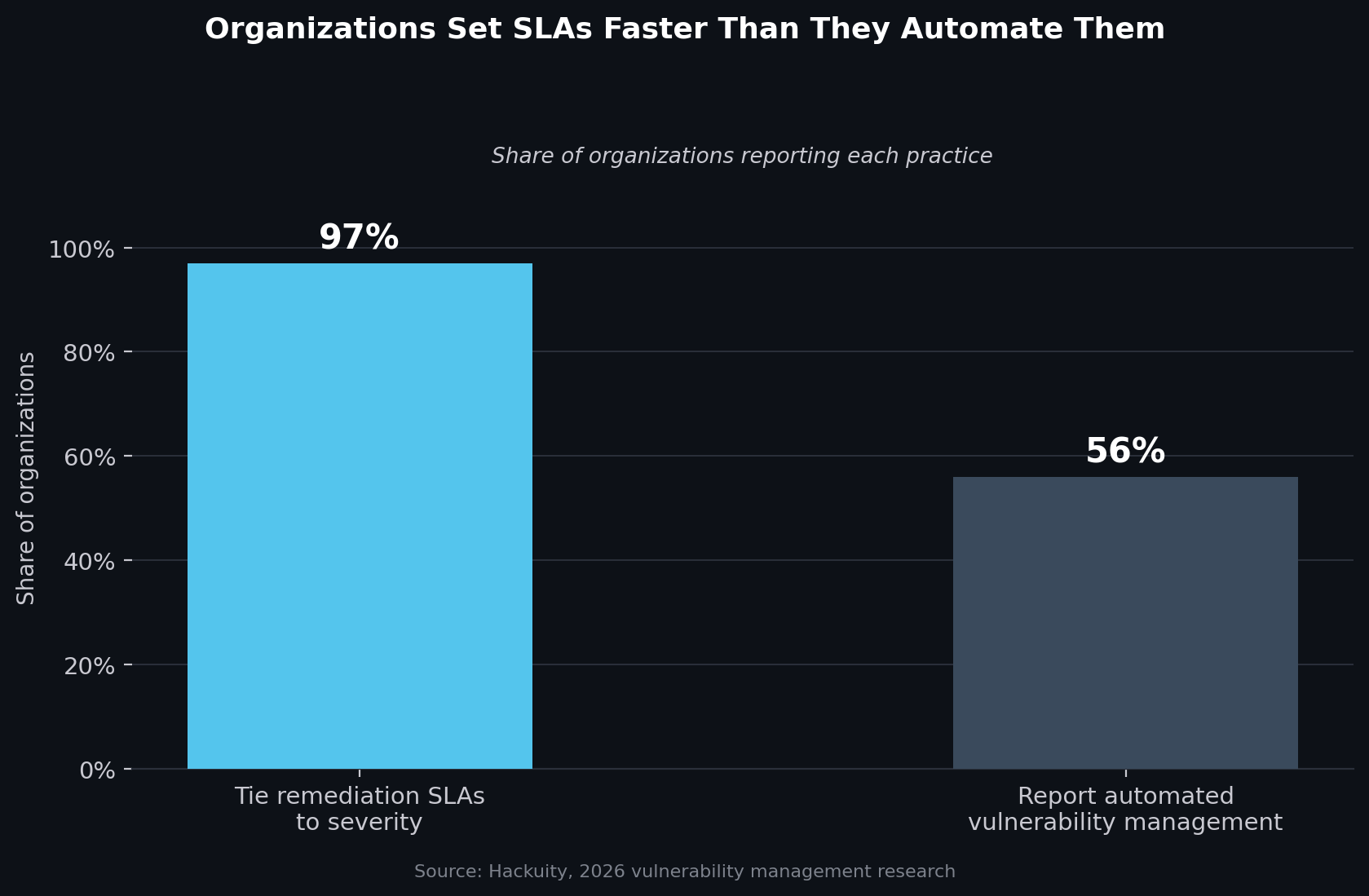
Vulnerability remediation guidance consistently identifies ownership ambiguity as a primary point of failure: a finding surfaces, but responsibility for the fix may sit with application owners, infrastructure teams, cloud teams, or endpoint operations, and a finding routed to a broad queue rather than a specific, accountable owner is measurably harder to resolve than one assigned directly. Research on vulnerability management practices found that 97 percent of organizations tie remediation SLAs to severity, but only 56 percent report having automated vulnerability management in place to actually meet them.
This is a meaningful gap between stated intention and operational capability. An SLA that exists on paper but isn’t enforced through automated routing, tracking, and escalation is a policy, not a process, and the evidence suggests a substantial share of organizations are operating with the former rather than the latter.
The Documented Problem: A Shrinking Window Between Disclosure and Exploitation
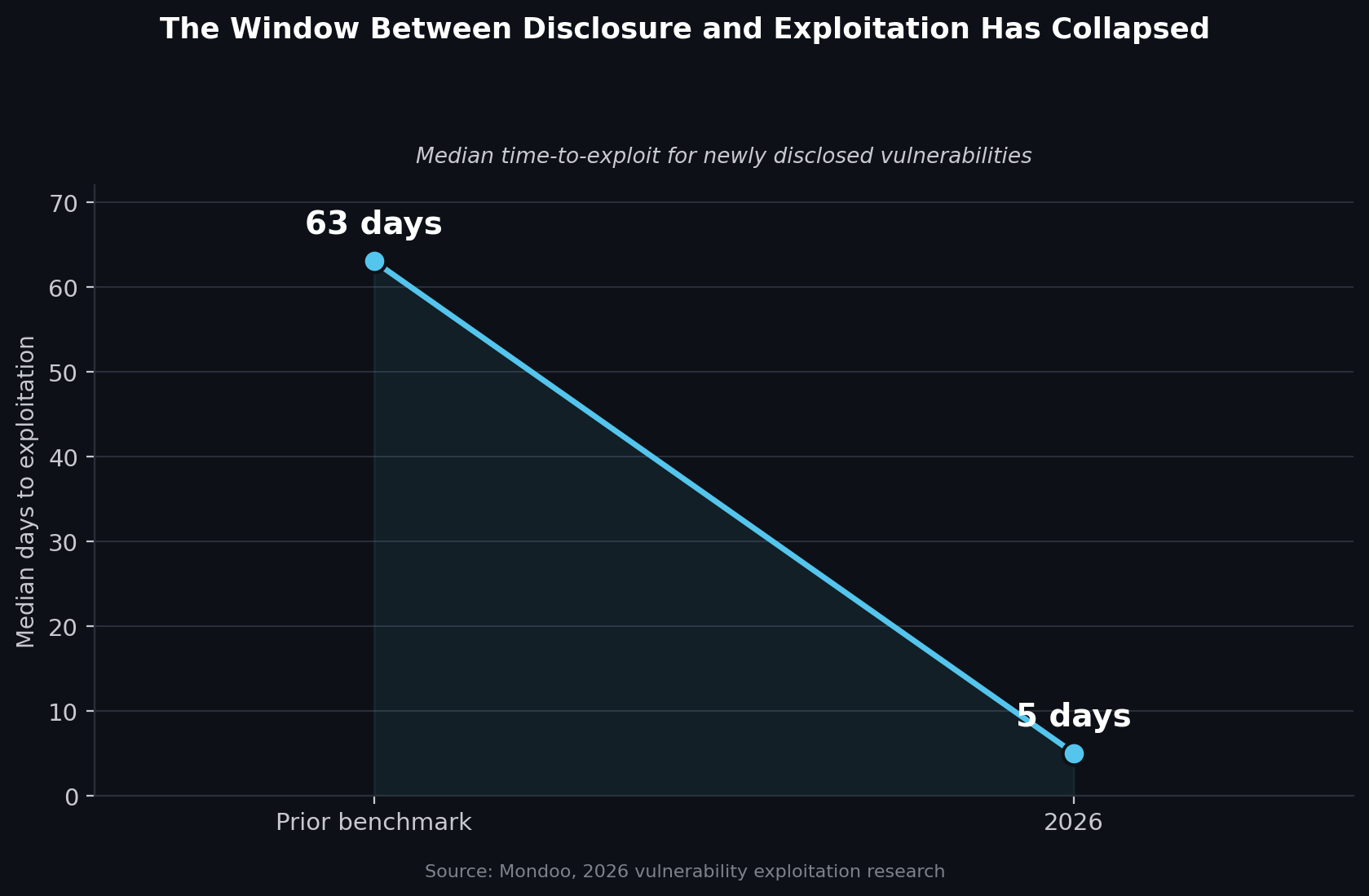
The cost of that gap has been rising because the time available to close it has been shrinking. Research on vulnerability exploitation timing found the median time between disclosure and active exploitation fell from roughly 63 days to about 5 days.
This compression is corroborated by other current findings: Verizon’s 2026 Data Breach Investigations Report found that vulnerability exploitation overtook credential abuse in 2025 to become the single most common way attackers gain initial network access, the first time that’s happened in the report’s 19-year history. The same report found a 43-day median time to fully resolve known-exploited vulnerabilities specifically, while only 26 percent of such vulnerabilities were fully remediated during 2025, a reminder that median resolution speed and actual completion rate are different measures, and a fast median can still coexist with most findings left open.
What Automated, Context-Unified Threat Modeling Is Designed to Address
Given Sections 2 and 3, a platform aiming to close this gap needs to do more than generate accurate findings faster. It needs to route each finding to a specific, accountable owner rather than a general queue, track that finding against an enforceable deadline rather than a policy that exists only on paper, and prioritize the routing itself by business consequence rather than technical severity alone, since severity-only prioritization is exactly the SLA-setting approach the data above shows is common but insufficiently automated.
How Fork’s Architecture Addresses These Specific Problems
Fork is built around two integrated components addressing this sequence directly. The first unifies code, runtime, and business context into a single view of each finding’s actual impact, allowing prioritization by business consequence rather than technical severity alone, a distinction Section 2’s data suggests most organizations have not yet operationalized even where they’ve set severity-based SLAs. The second, response orchestration, automates the ownership routing and SLA tracking that Section 2 identifies as commonly under-automated: findings are routed to a specific owner rather than a general queue, tracked against a defined timeframe, and escalated according to that timeframe rather than left to informal follow-up. This is a direct architectural response to the 97-to-56 gap in Figure 1, automating specifically the part of the process that data shows is least automated industry-wide.
What Isn’t Independently Verified
It’s worth stating plainly what this paper does not claim. The problems described in Sections 2 and 3, ownership ambiguity, the SLA-automation gap, and the shrinking exploitation window, are documented by independent, third-party research. Fork’s architecture, described in Section 4, is a specific response to those documented problems. Whether that specific response measurably outperforms alternative approaches, or how much it actually reduces remediation time or improves prioritization accuracy in practice, is not something this paper can point to independent, third-party benchmark data for. That data does not currently exist in public form for Fork or, to this paper’s knowledge, for most comparable platforms in this category. The architectural description above should be read as a design response to a documented problem, not as a demonstrated outcome.
Limitations and Open Questions
This paper’s argument has specific limits beyond the one stated directly above. First, the ownership-ambiguity and SLA-automation research cited in Section 2 describes vulnerability management broadly, not threat-modeling-specific findings routing specifically; the extension to threat modeling output is a reasoned inference based on structural similarity, not a direct measurement of the same workflow. Second, the exploitation-timing data in Section 3 comes from different sources with different methodologies (Mondoo’s time-to-exploit research and Verizon’s DBIR dataset), and should be read as directionally consistent evidence rather than a single coherent measurement. Third, this paper cannot rule out that some of the gap in Figure 1 reflects organizations that have deliberately chosen not to automate certain remediation workflows for reasons not captured in the underlying research, rather than an unaddressed capability gap in every case.
Conclusion
The case for a platform that unifies business context with automated ownership routing and SLA tracking rests on well-documented, externally verified problems: most organizations set severity-based remediation SLAs without automating the work to meet them, and the window between vulnerability disclosure and exploitation has compressed from roughly two months to about five days. Fork’s architecture, unifying code, runtime, and business context for prioritization, and automating ownership routing and SLA tracking for remediation, is a direct response to those two documented gaps. Whether that specific response outperforms alternatives is not established by independent, third-party data, and this paper does not claim otherwise.
References
- Hackuity. 2026 vulnerability management research (SLA-severity and automation figures).
- Mondoo. 2026 vulnerability exploitation research (time-to-exploit figures).
- Verizon. 2026 Data Breach Investigations Report (DBIR).
- SecPod. Vulnerability Remediation Tracking for Security Teams, 2026 (on ownership ambiguity).
- Orca Security. 2026 State of Application Security.